
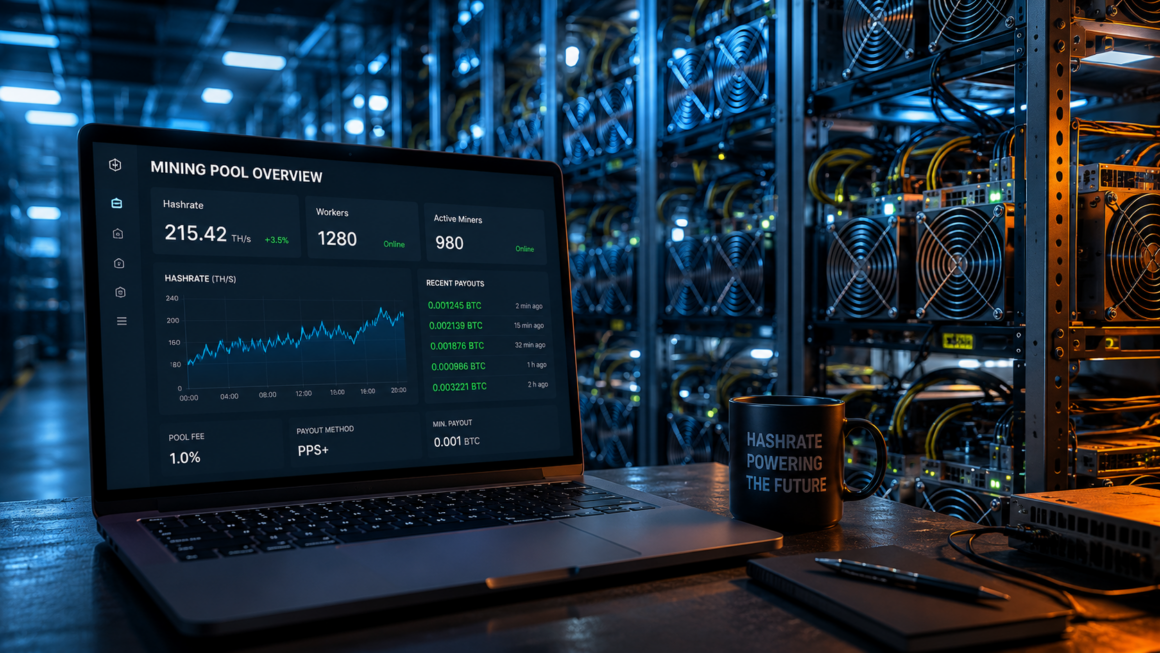
Choosing the right mining pool is one of the first serious decisions a crypto miner has to make. For many beginners and smaller operators, finding the best mining pool can make mining more predictable, reduce reward volatility, and help avoid turning expensive hardware into a lottery machine. The wrong pool, on the other hand, can quietly eat into profits through high fees, poor uptime, unclear payout rules, or weak infrastructure.
Crypto mining has changed a lot since the early Bitcoin days. Back then, a hobbyist could run hardware at home and still feel like they were directly competing for rewards. Today, mining is more competitive, more specialized, and much less forgiving.
That is why mining pools matter. They allow individual miners to combine hashrate, share rewards, and reduce the brutal randomness of solo mining. A solo miner can still hit a block, but for most people, that is closer to buying a lottery ticket with industrial fans attached.
What a mining pool actually does
A mining pool combines the computing power of many miners and points it toward the same proof-of-work network. When the pool finds a block, the reward is distributed among participants according to their contributed hashrate and the pool’s payout rules.
This does not mean every miner gets rich. It means the income pattern becomes more predictable. Instead of waiting months or years for a possible solo block, miners receive smaller, more regular payouts.
The pool operator usually handles block construction, job distribution, reward accounting, payout processing, and infrastructure uptime. The miner provides hashrate. The pool turns that hashrate into a more manageable income stream.
Solo mining vs pool mining
Solo mining means one miner tries to find a block independently. If successful, the miner receives the full block reward and transaction fees, minus any infrastructure costs. If unsuccessful, there is no payout.
Pool mining works differently. Miners contribute hashrate to a shared pool. When the pool finds a valid block, participants receive a portion of the reward based on their contribution.
The trade-off is simple: solo mining offers higher upside but much higher variance, while pool mining offers lower individual upside per block but more consistent payouts.
For large industrial miners, solo mining can sometimes be part of a broader strategy. For smaller miners, it is often financially painful. Bitcoin mining difficulty is high, competition is global, and the network does not care how motivational a home setup looks on YouTube.
Why payout models matter
The payout model decides how and when miners get paid. This is one of the most important details when choosing a pool.
Common models include:
- PPS — Pay Per Share: miners are paid a fixed amount for each valid share submitted. This is predictable, but pool fees are often higher because the operator takes on more risk.
- FPPS — Full Pay Per Share: similar to PPS, but it also includes an estimated share of transaction fees.
- PPLNS — Pay Per Last N Shares: miners are paid based on shares submitted during a specific window before a block is found. This can be more profitable during good periods but less predictable.
- SOLO pool mode: miners use pool infrastructure but keep the full reward if they personally find a block.
There is no universally perfect payout model. PPS and FPPS are usually better for miners who value stable cash flow. PPLNS may appeal to miners willing to accept more variance. SOLO mode is for miners who enjoy risk, mathematics, and emotional damage.
What makes a mining pool worth using
The best mining pool is not always the biggest pool. Size matters, but it is not the only factor.
A large pool may find blocks more often, which can make payouts more regular. But large pools also raise decentralization concerns if too much hashrate becomes concentrated in a small number of operators. Bitcoin was not designed so everyone could proudly recreate the banking system with extra heat.
Miners should look at several practical factors.
1. Transparent fees
Pool fees directly reduce mining revenue. A pool charging 1% and a pool charging 4% may look similar on the surface, but over time the difference matters.
Miners should check whether the published fee includes everything or whether there are additional withdrawal fees, conversion fees, hidden spreads, or payout restrictions.
A low fee is useful only if the pool is reliable. A cheap pool that frequently goes offline is not cheap. It is just a creative way to lose money.
2. Stable uptime
Mining hardware earns only when it is connected and submitting valid shares. Downtime means wasted electricity, lower income, and worse efficiency.
A good pool should offer stable servers, multiple regional endpoints, clear status pages, and quick incident communication. Server location also matters because latency can affect stale shares.
If a miner is in Europe, Asia, or North America, the pool should have nearby infrastructure. Otherwise, the miner may be doing everything right while packets travel the scenic route.
3. Clear payout rules
Minimum payout thresholds can affect cash flow, especially for smaller miners. If the threshold is too high, miners may wait longer to receive funds.
Before joining a pool, check:
- minimum payout amount;
- payout frequency;
- supported payout currencies;
- wallet requirements;
- fee deductions;
- whether transaction fees are shared;
- whether payouts are automatic or manual.
The rules should be clear before mining starts. “We explain it later” is not a payout model.
4. Reputation and operating history
Mining pools handle real value. Reputation matters.
A reliable pool should have a visible operating history, public documentation, consistent communication, and no pattern of unexplained payout issues. Miners should also check community feedback, but with caution. Crypto forums can turn one delayed payout into a courtroom drama in three replies.
The key is not to believe every complaint or every glowing review. Look for patterns.
5. Supported coins and merged mining
Some pools support only Bitcoin. Others support multiple proof-of-work coins such as Litecoin, Dogecoin, Bitcoin Cash, Ethereum Classic, Kaspa, or other mineable assets.
For miners with flexible hardware, multi-coin support can be useful. For miners focused only on Bitcoin ASICs, the main priority is usually pool reliability, fees, and payout structure.
Merged mining can also matter in some networks because it allows miners to earn rewards from more than one chain using the same work. But miners should understand the mechanics before assuming it automatically improves profitability.
Pool size and decentralization risk
Large mining pools can make income more predictable, but they also concentrate influence.
A pool does not necessarily own all the machines connected to it. Many independent miners can point hashrate to the same operator. Still, if too much network hashrate flows through too few pools, the ecosystem becomes more dependent on those operators.
That does not mean miners should avoid large pools entirely. It means they should understand the trade-off. The most convenient option is not always the healthiest one for the network.
Decentralization is not a marketing sticker. It is part of what makes proof-of-work networks resistant to manipulation, censorship, and single points of failure.
The hidden cost of bad pool selection
Choosing the wrong pool can reduce mining profit in quiet ways.
A miner may lose money through high stale share rates, poor uptime, unclear fees, delayed payouts, weak support, or bad payout model selection. None of these problems looks dramatic at first. They just slowly shave revenue until the miner wonders why the numbers do not match the spreadsheet.
The most dangerous pool is not always an obvious scam. Sometimes it is simply inefficient, poorly maintained, or unsuitable for the miner’s hashrate and location.
Mining already has enough variables: hardware price, electricity cost, network difficulty, coin price, cooling, maintenance, and regulation. The pool should reduce uncertainty, not add another layer of chaos with a login page.
How beginners should compare mining pools
New miners should avoid choosing a pool only because it appears in a top-ten list. Rankings are useful, but they rarely know your electricity price, hardware type, risk tolerance, or payout needs.
A practical comparison should include:
- supported coin;
- pool fee;
- payout method;
- minimum payout;
- server regions;
- historical uptime;
- stale share rate;
- user reputation;
- documentation quality;
- support response quality.
For small miners, predictable payouts may be more valuable than chasing slightly higher theoretical returns. For larger miners, even small fee differences can matter because they compound across significant hashrate.
A spreadsheet is boring. In mining, boring is often where the truth lives.
Common mistakes when choosing a mining pool
One common mistake is focusing only on fees. A lower fee does not help if the pool has poor uptime or weak infrastructure.
Another mistake is ignoring the payout model. A miner expecting steady income may become frustrated with a model that creates more variance. The pool may not be bad; it may simply be the wrong fit.
Some miners also forget about geography. Server distance can affect latency and stale shares. A miner should test actual performance rather than rely only on a pool’s homepage claims.
Finally, many beginners underestimate electricity cost. A good pool cannot rescue an unprofitable setup forever. It can improve consistency, but it cannot turn bad unit economics into magic.
Mining pool selection checklist
Before choosing a pool, miners should answer a few direct questions:
- What coin am I mining?
- What hardware am I using?
- What is my electricity cost?
- Do I need predictable payouts or can I tolerate variance?
- Does the pool share transaction fees?
- Are fees and payout rules clearly explained?
- Are servers available near my region?
- Is the minimum payout realistic for my hashrate?
- Does the pool have a stable operating history?
If the answer to several of these questions is unclear, the miner should slow down. Mining rewards are hard enough to earn. They should not be handed to a poorly understood pool by default.
Final thoughts
The best mining pool is not just the one with the biggest name, the lowest advertised fee, or the flashiest dashboard. It is the pool that fits the miner’s hardware, location, payout needs, risk tolerance, and long-term strategy.
For most miners, pool mining is more practical than solo mining because it reduces reward variance and creates steadier income. Solo mining still exists, but for smaller participants it is usually a high-risk bet rather than a dependable business model.
A good pool should make mining simpler, not mysterious. If it offers transparent fees, reliable uptime, clear payouts, fair accounting, and strong infrastructure, it is doing the job.
Everything else is just noise with a hashrate counter.